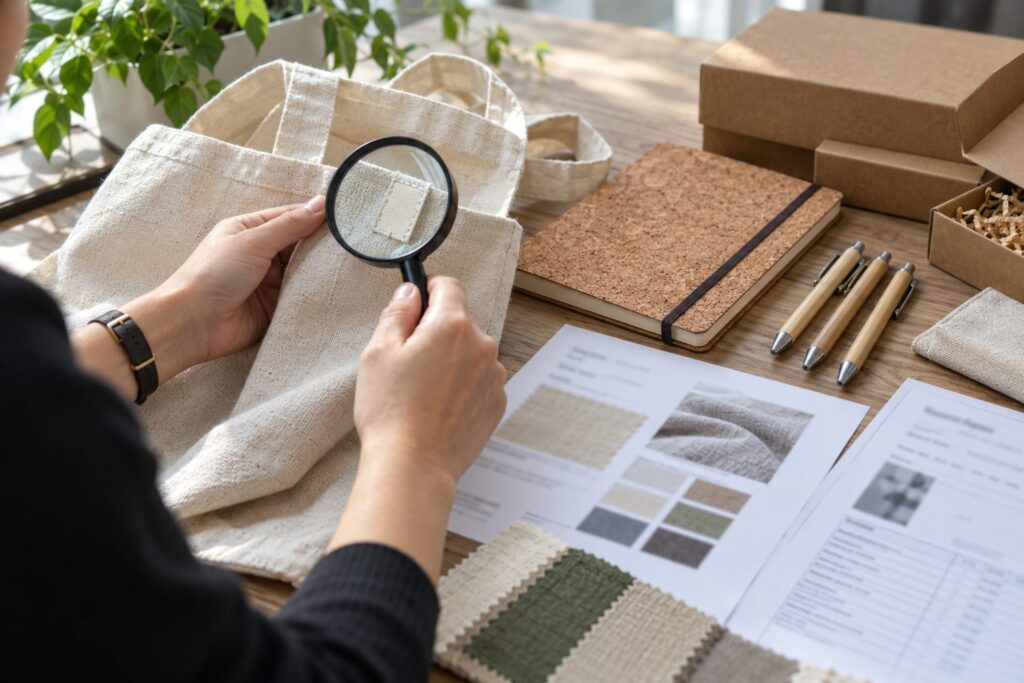
Almost every promotional products catalogue now has an eco range. Some of those products are genuinely better choices. Others carry vague labels such as green, natural or planet friendly with nothing behind them. If you repeat a supplier’s claim in your own marketing or on your stand, you take on some of the risk if it turns out to be misleading. This guide explains what UK rules say about environmental claims, what the common labels mean, and the questions to ask a supplier before you buy eco-friendly promotional products.
Why the claims matter
The Competition and Markets Authority (CMA) published its Green Claims Code to help businesses make environmental claims that comply with consumer protection law. The code says claims must be truthful and accurate, clear and unambiguous, must not omit or hide important information, must make fair and meaningful comparisons, must consider the full life cycle of the product, and must be substantiated. The CMA’s own campaign site notes that 40% of green claims made online could be misleading.
The risk went up in April 2025, when consumer protection provisions in the Digital Markets, Competition and Consumers Act 2024 came into force. The CMA can now decide for itself whether consumer law has been broken and can fine a company up to 10% of its global turnover. The law applies to claims made to consumers, so if you hand out a bottle described as eco or recycled, or describe your merchandise that way on social media, it is worth knowing the claim stands up.
| Principle | What it means for a branded product | Example of a weak claim |
|---|---|---|
| Truthful and accurate | The product really has the benefit claimed | A bottle called recycled when only the lid is |
| Clear and unambiguous | Specific wording a buyer understands | Planet friendly, with no explanation |
| Nothing important left out | Disclose trade-offs that would change the decision | Bamboo fibre praised without saying it is blended with plastic |
| Fair comparisons | Compare like with like and say against what | 50% less plastic, with no baseline given |
| Full life cycle | Consider materials, making, transport, use and disposal | Compostable, when it needs an industrial facility most people cannot reach |
| Substantiated | Evidence exists and can be produced | Certified sustainable, with no named scheme or certificate |
What common labels actually mean
Recognised certification schemes are the easiest evidence to check, because each has a public standard and a way to verify certificates. They each cover something specific, so a label on one part of a product does not make the whole product eco-friendly.
| Label | What it covers | What it does not tell you |
|---|---|---|
| FSC | Wood and paper from responsibly managed forests, tracked through the supply chain | Anything about the other materials in the product |
| GRS (Global Recycled Standard) | Recycled content, chain of custody and some social and chemical requirements | That the whole product is recycled, unless the percentage says so |
| RCS (Recycled Claim Standard) | Recycled content and chain of custody | Social or chemical standards |
| GOTS | Organic fibre in textiles plus environmental and social criteria in processing | Products with low organic content outside its rules |
| OEKO-TEX Standard 100 | The finished textile has been tested for harmful substances | Anything about recycled, organic or low-impact production |
| Fairtrade | Fair terms for farmers and workers, for example on cotton | The environmental impact of the finished product |
| B Corp | The company as a whole meets B Lab’s standards | The impact of any single product it sells |
Questions to ask a supplier
- What exactly is recycled, organic or certified, and what percentage of the product does that cover?
- Which scheme certifies it, and can you send the certificate or licence number?
- Is the certification for the material, the factory or the finished product?
- Where is the product made, and how is it shipped to the UK?
- What is the packaging made from, and can it be reduced?
- Can the product be recycled or repaired at the end of its life, and how?
- Are you happy for us to quote your claim, word for word, in our own marketing?
A supplier who can answer these quickly and send documents is far safer to buy from than one who points only to a leaf icon on the product page.
Choosing products that are better in practice
The most effective step is often to buy fewer items that last longer. A durable bottle or bag that gets used for years usually has a lower impact per use than several cheap items that are thrown away. Avoid adding dates or event names so spare stock can be used again, and avoid single-use giveaways that end up in the bin by the end of the day.
Look at UK-made options too. Some suppliers manufacture or decorate in the UK, which can shorten supply chains and make it easier to check how products are made, though UK-made is not automatically lower impact. Plantable products, such as seed paper, can be a good fit for some campaigns if the seeds are suitable for UK planting.
Finally, keep your own wording modest. Describing a product as made from 80% recycled polyester, certified to GRS, is clear and checkable. Calling a campaign sustainable merchandise without detail is the kind of claim the CMA guidance warns against.
Where to find suppliers
Our eco and sustainable merchandise category lists UK suppliers with eco ranges, with narrower lists for recycled products, seed paper and plantables, UK-made merchandise and sustainable corporate gifts. Popular product categories with recycled options include eco and recycled pens, water bottles and jute and eco bags. Each listing links to the supplier’s own website so you can read their claims and ask for evidence directly. If you are buying for an event, our guide to exhibition giveaways that people keep covers how to reduce waste on the stand.
Sources
- Competition and Markets Authority, Making environmental claims on goods and services, published 20 September 2021, checked 26 October 2026.
- Competition and Markets Authority, Green Claims Code campaign site, checked 26 October 2026.
- Competition and Markets Authority, CMA to boost consumer and business confidence as new consumer protection regime comes into force, 7 April 2025, checked 26 October 2026.
- Scheme owners, for scope and certificate checks: FSC; Textile Exchange, Global Recycled Standard and Recycled Claim Standard; GOTS; OEKO-TEX Standard 100; Fairtrade Foundation; B Lab UK. Checked 26 October 2026.