

Most exhibition giveaways are picked up without thought and thrown away within days. The ones that work are useful, well made and chosen for a reason: to start a conversation on the stand, to thank someone who gave you their time, or to keep your name in front of a buyer after the show. This guide sets out how to choose trade show giveaways that people keep, how many to order, and how to plan the order so it arrives before the show.
Decide what the giveaway is for
Before you choose a product, decide what job it has to do. A giveaway that pulls people onto the stand is a different product from one that rewards a booked meeting. Many exhibitors use two or three tiers: a low-cost item for anyone who stops, a better item for people who leave their details, and a small number of premium gifts for qualified prospects and existing customers.
| Purpose | Who gets it | Good choices | Watch out for |
|---|---|---|---|
| Start conversations | Anyone who stops | Branded sweets or mints, pens, stickers, lip balm | Running out on day one; items too cheap to reflect your brand |
| Reward a scan or sign-up | Visitors who leave details | Tote bags, notebooks, phone accessories, cable sets | Bags so thin they are left at the hotel |
| Thank a meeting | Booked appointments and prospects | Insulated bottles, travel mugs, power banks, quality notebooks | Weight and bulk for visitors who are travelling |
| Keep in touch after the show | Hot leads and key customers | A posted gift after the event, branded clothing | Sending before you have qualified the lead |
What makes a giveaway worth keeping
People keep things they use. At a show that usually means items that solve a small problem during the day or at the desk afterwards: something to write with, something to drink from, something to carry other things in, or something to charge a phone. Visitors also keep items that are better than they expected, so a good-quality version of a common item often outperforms a novelty.
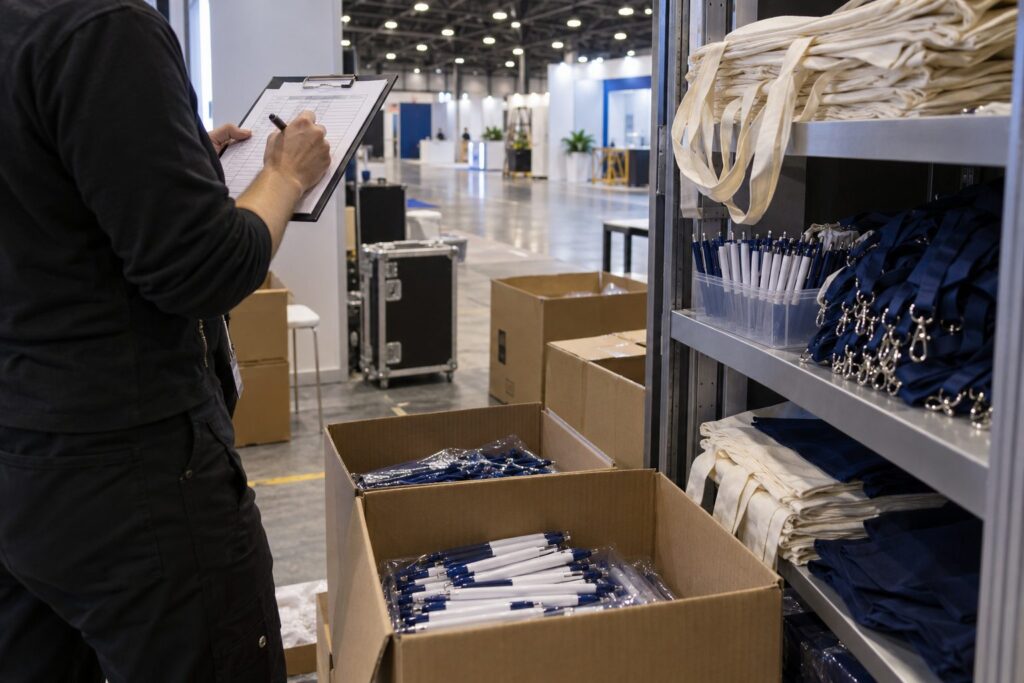
Think about the journey home. Many visitors arrive by train or plane, so heavy or bulky items are a burden. Something small, light and useful is usually the better choice. If you want to give something larger, offer to post it after the show, which also gives you a reason to follow up.
Branding matters too. A small, neat logo on a quality product is more likely to be used in public than a large logo, a long web address and a strapline crammed onto a pen. Ask your supplier for a visual at actual size before you approve it.
How many to order
Exhibitors often order too many cheap items and too few good ones. A simple way to estimate quantities is to start from the show’s expected visitor numbers, which the organiser usually publishes, then work down to the people who are likely to stop at your stand.
| Step | Example figure | Where it comes from |
|---|---|---|
| Expected visitors over two days | 6,000 | Organiser’s published figure |
| Share likely to be in your target market | 30%, so 1,800 | Your own judgement of the audience |
| Share of those who stop at your stand | 15%, so 270 | Your results at previous shows |
| Tier one items (anyone who stops), with 20% spare | About 325 | 270 plus a margin |
| Tier two items (left their details) | About 130 | Half of those who stop, plus a margin |
| Tier three gifts (booked meetings) | 30 | Your meeting target for the show |
Leftover stock is not wasted if you choose items that work for other events, client visits or new starters. That is a good reason to avoid printing a show name or date on your giveaways.
Planning the order
Most branded products are made or printed to order. Even items described as express need artwork approved first, and the busiest exhibition months put pressure on production. Work back from the build day, not the show’s opening day, because the stock needs to be at the venue or with your stand team when the stand is built.
- Six to eight weeks before: agree the purpose, tiers and budget, and ask two or three suppliers for ideas and prices.
- Four to six weeks before: order samples of anything new, approve artwork and confirm delivery dates in writing.
- Two to three weeks before: production and delivery to your office or the venue, checked against the order.
- Show week: pack giveaways in labelled boxes by tier, and keep the better items out of sight until they are earned.
If the venue accepts deliveries, check its rules and the organiser’s exhibitor manual for delivery windows and labelling. Late deliveries to a hall during build can be refused or held.
Keeping costs and waste down
Exhibitors are increasingly asked about the environmental impact of what they hand out, and visitors notice when a stand gives away single-use plastic. Choose fewer, better items, avoid date-specific branding, and ask suppliers for evidence behind any recycled or eco claim before you repeat it on your stand. Our guide to checking eco claims on promotional products explains what to ask for.
There is also a tax point for UK businesses. HMRC’s business income manual says gifts that carry a conspicuous advertisement for the business are generally allowable, but not if the gift is food, drink, tobacco or a voucher, or if the gifts to the same person in the tax period cost more than £50 in total. That means branded sweets may be a good conversation starter but are treated differently from a branded pen or notebook. Ask your accountant how this applies to your business.
Where to find suppliers
Many UK suppliers specialise in event and stand merchandise, and some can deliver at short notice. Browse our exhibition and trade show giveaways category, or narrow it down to lanyards, tote bags, branded pens and branded sweets. If you also need the stand itself, our portable exhibition stands and pull-up banners categories list display suppliers. For larger events with delegate packs, see conference merchandise, and for local suppliers try London or Birmingham.
A short checklist
- Decide what each giveaway is for and who gets it.
- Choose useful, light items and a small, neat logo.
- Estimate quantities from the organiser’s visitor figures and your own past results.
- Avoid show names and dates so spare stock can be used again.
- Approve artwork early and work back from build day.
- Check the venue’s delivery rules.
- Follow up hot leads after the show, ideally with something worth keeping.
Sources
- HM Revenue and Customs, BIM45070, gifts carrying a conspicuous advertisement, checked 26 October 2026.
- Competition and Markets Authority, Green Claims Code, checked 26 October 2026.