
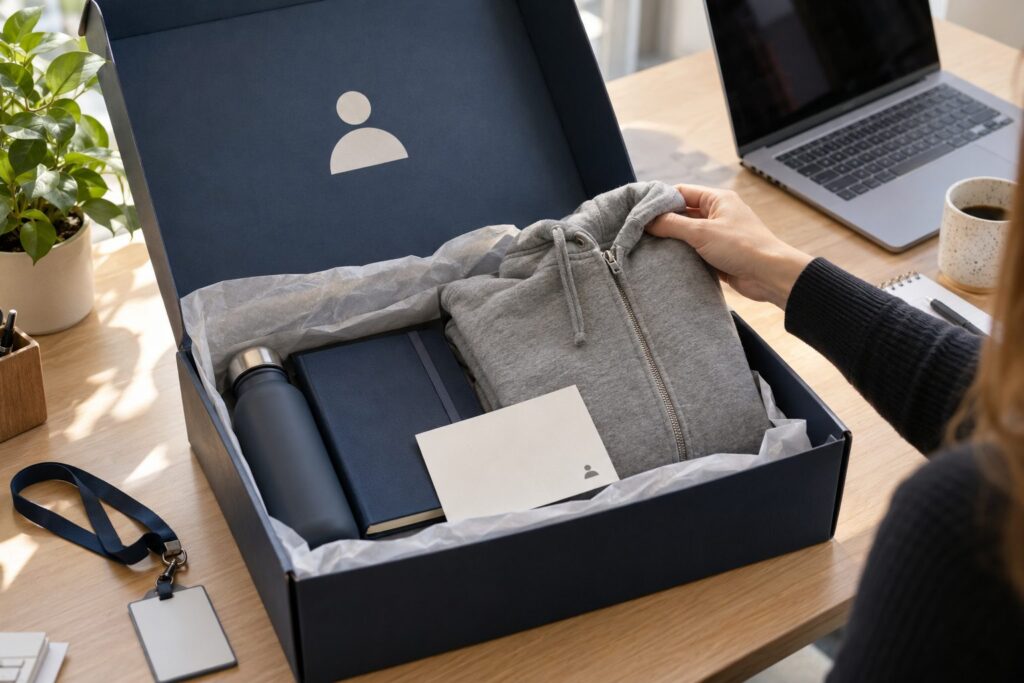
A welcome pack is the box, bag or envelope a new starter receives on or before their first day. A good one gives them what they need for the job, along with a few things that make them feel part of the team, and shows that someone planned for their arrival. A poor one is often a branded pen and a stress ball that end up in a drawer by Friday.
Employee welcome packs go by several names: new starter packs, onboarding packs, swag boxes or, when they are handed over in person, swag bags. This guide covers what to put in them, how to set a budget per person, how long the process takes, and how the tax rules on staff gifts affect what you spend. It is written for HR, people and office teams buying for a handful of hires a month or a large intake.
Start with what a new starter needs in week one
The most useful onboarding packs are built around the first few weeks of the job rather than around a product catalogue. Before you look at merchandise, list what a new person actually has to do in week one. Office staff may need a notebook, a pen that works, a lanyard and pass holder, and a bottle or cup for the kitchen. Field and site staff may need branded workwear, a hi-vis vest or a fleece in the right size. Remote staff need everything posted to their home, so the box has to survive the post and arrive before their start date.
Once the practical items are covered, add one or two things that people choose to use outside work: a good hoodie, a decent travel mug, a tote bag that is not too thin to carry shopping. These are the items that carry your brand outside the office, but only if the quality is good enough that people want to be seen with them.
| Item | Office or hybrid | Remote | Site or field |
|---|---|---|---|
| Notebook and pen | Yes | Yes | Optional |
| Lanyard and card holder | Yes | Only if visiting an office | Yes, often with a safety breakaway |
| Reusable bottle or travel mug | Yes | Yes | Yes, insulated |
| Branded clothing | Hoodie or T-shirt | Hoodie or T-shirt | Workwear in the correct size |
| Tote bag or backpack | Optional | Optional | Rarely |
| Tech accessory (charger, cable) | Optional | Useful | Optional |
| Printed welcome card or letter | Yes | Yes | Yes |
What to leave out
Cheap filler is the main reason swag boxes fail. Single-use items, novelty gadgets that break, poorly printed T-shirts in one size, and anything that looks like conference leftovers send the opposite message to the one you intend. If budget is tight, three good items beat eight weak ones.
Be careful with food and drink. Sweets and chocolates are popular, but they add allergen labelling questions, best-before dates and, for boxes posted to homes, a risk of melting or damage. If you include them, buy from a supplier that prints full allergen information on the wrapper and can tell you the shelf life.
Clothing needs sizes. Ask for sizes in the offer pack or the pre-start form rather than guessing, and choose a supplier that can hold a small stock of each size so you can send replacements. A hoodie that does not fit will not be worn, and it cost the same as one that does.
Setting a budget per person
Decide a budget per new starter before you ask for quotes. It keeps suppliers focused and makes it easier to compare offers. Remember that the unit price on a product page is rarely the whole cost: allow for branding set-up, packaging, any personalisation such as names, storage if the supplier holds stock for you, and postage to each home address.
For UK employers, the tax rules are worth checking before you set the figure. HMRC’s trivial benefits rule says you do not have to pay tax or National Insurance on a benefit for an employee if it cost £50 or less to provide, is not cash or a cash voucher, is not a reward for their work or performance, and is not in the terms of their contract. Directors of close companies are capped at £300 of trivial benefits in a tax year. A welcome pack given to everyone who joins is not a reward for performance, so many employers plan to keep the cost of each pack within that limit. If a pack costs more, or is part of a salary sacrifice arrangement, it may need to be reported. Check the current HMRC guidance or ask your accountant before you commit.
| Cost line | What it covers | Questions to ask the supplier |
|---|---|---|
| Products | The items themselves at your order quantity | Does the price change at the next quantity break? |
| Branding | Print, embroidery or engraving, plus any set-up charge | Is set-up charged once or on every reorder? |
| Packaging | Box, tissue, inserts, printed card | Is a branded box included or extra? |
| Packing | Assembling each box | Is kitting priced per box? |
| Storage | Holding stock between hires | How long is storage free, and what does it cost after that? |
| Delivery | Postage or courier to each address | Tracked delivery? International addresses? |
Swag boxes for one intake or a steady flow of hires
If you hire in batches, such as a graduate intake or a new office opening, you can order once, brand everything together and have the boxes packed and delivered in one run. That usually gives the best unit price.
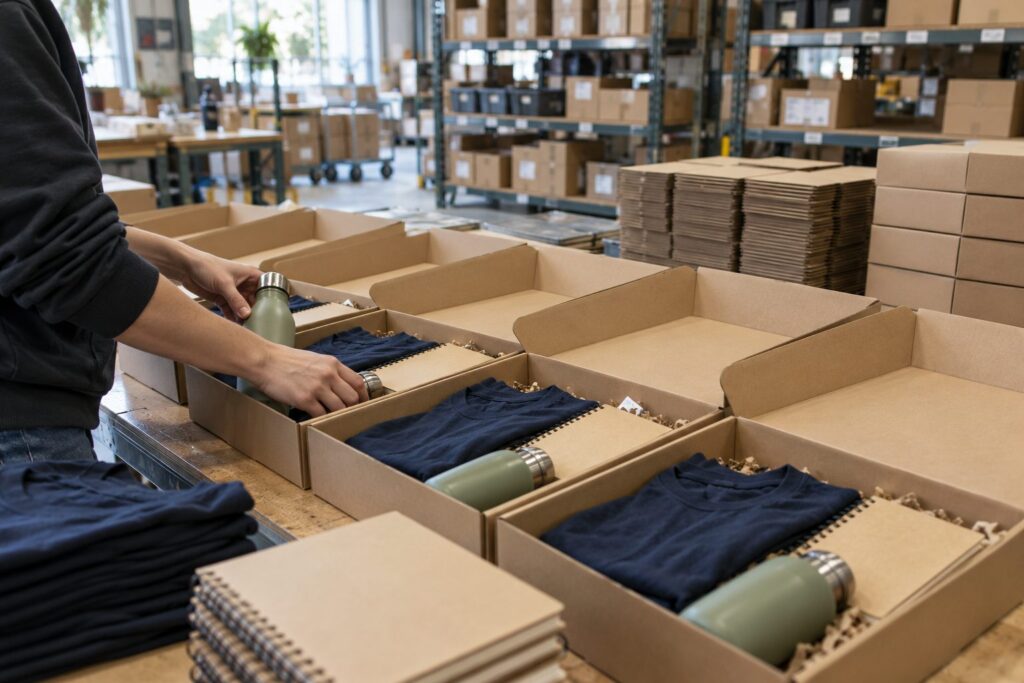
If you hire a few people every month, you need a different set-up. Several suppliers now offer a managed service where they hold branded stock, pack a box when you tell them someone is starting, and post it to the new starter’s address. Some run an online portal or a redemption link so the new starter picks their own size and gives their own delivery address. This costs a little more per box but removes the admin from your team and avoids ordering 200 hoodies to cover twelve hires.
When you compare these services, ask how stock is reported, what happens when an item runs out, how long a box takes to dispatch after you trigger it, and whether you can change the contents without starting again.
How long it takes
Allow more time than you think. Branded products are usually made to order, and proofs need approval before anything is printed. A realistic plan for a first order looks like this.
Reorders from stock the supplier already holds can go out in days. Custom packaging, printed boxes and embroidered clothing take longest the first time. If a start date is fixed, tell the supplier the date the box must arrive, not the date you would like it dispatched.
Choosing a supplier for welcome packs
Look for a supplier that has done onboarding packs before and can show examples. Ask whether they handle the whole job, from sourcing and branding to packing, storage and delivery, or whether they only supply the products. Check that they can send a physical sample of the finished box before the full order. If you care about sustainability, ask what the packaging is made from and what evidence they hold for any eco claims on the products.
You can browse UK businesses that offer this service in our welcome packs and swag boxes category, compare staff and employee gift suppliers, or look for a supplier that runs merchandise fulfilment and storage if you hire steadily through the year. For clothing in the box, see our guide to choosing a decoration method, and if you are planning merchandise for an event as well, read exhibition giveaways that people keep.
A short checklist
- List what a new starter needs in week one, then add one or two items people will use outside work.
- Set a budget per person that includes branding, packing and delivery.
- Check the current HMRC trivial benefits rules before you settle on the figure.
- Collect clothing sizes and delivery addresses before you order.
- Ask for a sample box and approve every proof.
- Give the supplier the date the box must arrive.
- For regular hiring, use held stock and a packing service rather than one large order.
Sources
- HM Revenue and Customs, Tax on trivial benefits, GOV.UK, checked 26 October 2026.
- HM Revenue and Customs, EIM21865, exemption for trivial benefits in kind, checked 26 October 2026.